
 Benjamin Booker
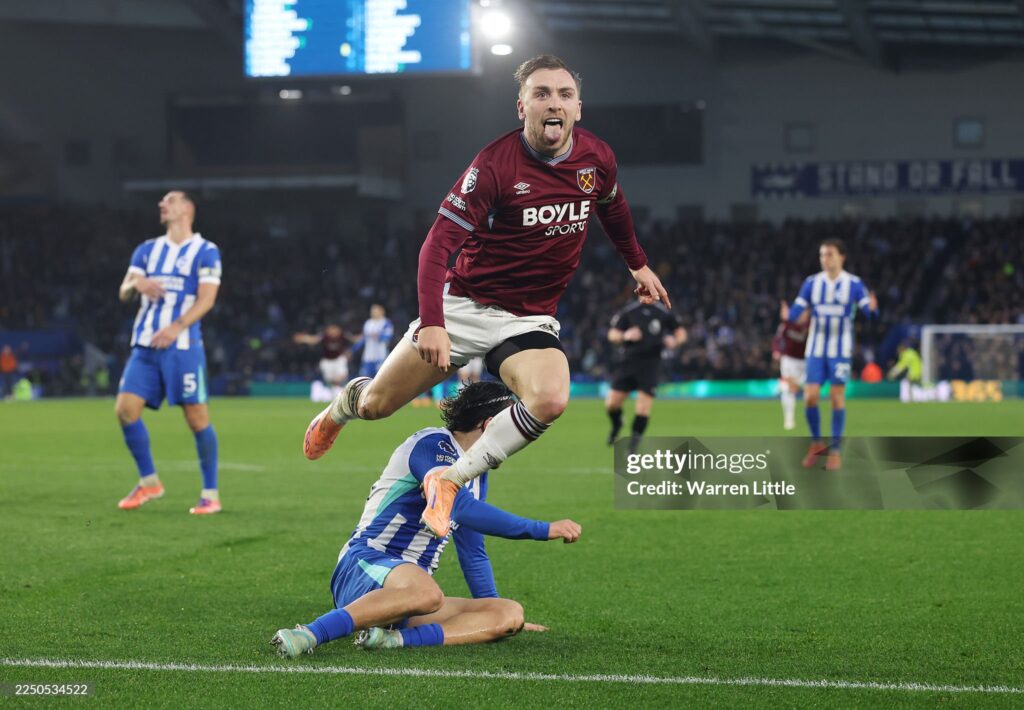
Daylight Robbery: How West Ham Threw Away The Perfect Heist
By Benjamin Booker
It takes a special kind of cruelty to defend perfectly for 89 minutes, only to shoot yourself in the foot in the 91st.
For the vast majority of this rain-soaked contest at the Amex, West Ham produced a masterclass in “Nuno-ball.” They surrendered the ball (31% possession), sat deep, and then cut Brighton open with surgical precision on the break. They should have won 2-0 or 3-0. Instead, they leave with a point that feels like a defeat, and Jarrod Bowen leaves wondering what more he has to do.
The final score was 1-1, but the “Expected Goals” (xG) tells the real story. West Ham created the big chances; Brighton simply held the ball.
The Verbruggen Wall
If Jarrod Bowen is the tragic hero of this season, Bart Verbruggen is the villain of this match. Before Bowen finally broke the deadlock, West Ham had already done enough to win.
- 17th Minute: Lucas Paquetá, showing a rare flash of his old self, forced a diving save from distance.
- 55th Minute: The game-defining moment. Bowen shrugged off Lewis Dunk and fired low, only for Verbruggen to save. The rebound fell to Crysencio Summerville four yards out—a certain goal—but the Brighton keeper reacted miraculously to tip it over.
West Ham weren’t “lucky” to be in the game; they were being denied by a goalkeeper having the match of his life.
The Engine Room: Fernandes’ Masterclass
While Bowen provided the spark and Verbruggen the villainy, Mateus Fernandes was the heartbeat of West Ham’s near-perfect heist. Operating in the engine room, the Portuguese midfielder produced arguably his finest performance in a West Ham shirt to date.
Often overshadowed by the flare of Paquetá or the electric pace of Crysencio Summerville, Fernandes was a one-man wrecking crew against Brighton’s possession-heavy midfield. The stats paint a picture of relentless industry: he won 16 duels—the most by any player in a Premier League match this season. He was the embodiment of “Nuno-ball,” snapping into tackles, breaking up play, and immediately launching counters with crisp, intelligent distribution.
In the first half alone, he was the best player on the pitch. He didn’t just destroy; he created. It was his vision that released El Hadji Malick Diouf for a shot that rattled the side-netting, and his energy that kept Brighton’s midfield uncomfortable for 80+ minutes.
Nuno’s decision to substitute him for Soungoutou Magassa in the 83rd minute was understandable—Fernandes had run himself into the ground—but his departure coincided with West Ham losing their grip on the midfield. With him on the pitch, the heist looked secure; without him, the vault door was left just slightly ajar.
The Breakthrough: The Wilson Effect
Nuno Espírito Santo is often criticized for his substitutions, but his introduction of Callum Wilson in the 72nd minute was a stroke of genius. Less than sixty seconds after coming on, Wilson did what a target man does best: he occupied the centre-backs. His hold-up play created a fractured defensive line, and his perfectly weighted pass found Bowen in the right half-space. For once, Bowen didn’t have to beat three men. He just had to beat the keeper. He slotted it home, sending the away end into delirium. It was a goal born from partnership, not isolation.
The Cruel Twist: Brighton’s “First” Shot
The tragedy of the result lies in the defensive stats. Minutes 0–88: Brighton Shots on Target: 0. West Ham had nullified them completely. The defensive shape was immaculate. Jean-Clair Todibo and Max Kilman won every aerial duel.
But football is a 90-minute game. In the 89th minute, Brighton registered their first shot on target. Two minutes later, in stoppage time, Georginio Rutter found half a yard of space in a crowded box. His scuffed finish—checked agonizingly by VAR for a handball—trickled in.
The Hand of Rutter: Progression by Loophole
While the headlines will focus on the VAR “technicality,” the mechanics of the handball itself are what make the result so bitter for West Ham.
The ball didn’t just graze Georginio Rutter; his arm was fundamental to how the ball progressed from a chaotic scramble into a goal-scoring chance. As Charalampos Kostoulas attempted an acrobatic overhead kick, the ball ricocheted off Rutter’s thigh and popped up, striking his trailing arm.
Crucially, this contact deadened the ball’s momentum. Instead of bouncing away or looping awkwardly, the ball dropped perfectly into Rutter’s stride, allowing him to set himself for the initial volley that Alphonse Areola miraculously saved. Without that touch of the arm—accidental or not—Rutter likely never gets control of the ball to unleash the first shot that created the chaos for his second, successful attempt.
It was a textbook example of an unfair advantage gained through an infringement, yet because of the “reset” caused by Areola’s save, the letter of the law decided that Rutter’s arm had no bearing on the final outcome. In reality, it had everything to do with it.
It was a goal Brighton barely deserved, but one West Ham’s fragile confidence could not withstand.
The Verdict: Progress, But Painful
This wasn’t the “abject surrender” we saw earlier in the season. The counter-attacking threat was real (4 shots on target to Brighton’s 2). The partnership between Bowen and Summerville looked electric at times.
But the table doesn’t care about “better performances.” It cares about points. Jarrod Bowen did everything right. He scored, he led, he pressed. But as he walked down the tunnel, shaking his head at the VAR monitor, the reality set in: West Ham are playing well enough to stay up